Saturday, June 16, 2012
two years in tanzania.
Two years ago today I stared out the window of the airplane at giraffes and elephants frolicking in the plains below and became overwhelmed by the realization that my dreams of living and working in Africa were finally coming true. I knew little about the roller coaster ride I was about to embark on, but with a group of 40-some other people knowing just as little as I did, we stepped out into the suffocating humidity and heat of Dar es Salaam and into a country that would change us all.
Two years later I look back at the places I've been, the people I've met, the things I've seen and done, and I'm at a loss of words at how to sum it up. If you would have told me two years ago that I would be teaching 7th graders how to use condoms, building toilets in the middle of nowhere, holding a conversation with a tailor about how he no longer supports Obama because of his stance on gay marriage - in Swahili, or unwrapping an umbilical cord from a newborn baby's neck helping him to take his first breath, I would have told you you've lost your damn mind.
Two years ago if I would have known I would go through some of the things I've experienced here I'm not sure I would have gotten on the plane. But I am thankful everyday that I did; that I've experienced everything that I've experienced, learned everything that I've learned - good and bad, beautiful and heartbreaking. When I was very serious about throwing in the towel if one more fly landed on me, I had friends and neighbors to turn to who knew exactly how I felt and who helped me put things into perspective and remember why I'm here.
I've been pushed to my limits - in good ways and not so good ways - and learned that there is absolutely nothing I can't do. Peace Corps has taught me that, Tanzanians have taught me that. And for that I am thankful.
Here's to all of you in our health and environment training class of 2010 who have strived everyday (well almost everyday...) to make a positive difference in the lives of others. Here's to ugali and mlenda, obnoxious kondas, unforgettable sunsets, drunk bibi's, village runs, that rooster who woke me up every morning at 4:30, a shy student asking for help getting birth control, bats/cockroaches/rats/scorpions, fetching water, no privacy, volleyball, tanzanian buses, call to prayer, climbing the boulders with neighbor kids, and all of the other things that will forever remind us of our time in Peace Corps Tanzania. we did it!
Tuesday, May 29, 2012
work. or something like it.
I'm sure a good number of you are wondering what in the world I've been up to other than roaming around Tanzania and/or sitting in my courtyard reading The Clan of the Cave Bear. Well here's a quick look at some of the projects we've been cookin' up...
In rural Tanzania, people have little access to a place where they can purchase everyday household items and foodstuffs. Most villages have small shops where they can find salt, soap, and other little things, but many areas rely heavily on the traveling markets that set up show in the village every few weeks. In my village, Sepuka, our market days happen twice a month and people travel up to a half day by foot, donkey, or bike for access to everything from new dishes and fruits/vegetables, to beds, bikes, and livestock. A rough estimate by the Ward District Council in my village puts an average market day attendance at around 1,000 people. The market in Sepuka Ward is the largest in the area and provides more selection than any other small market.
The village government approached me In June of last year with concerns about the health and well being of community members, especially those traveling to the market and those living in the surrounding area. Due to the lack of public latrines in the market area, villagers who attend the bi-monthly market openly relieve themselves in the surrounding area resulting in the contamination of a nearby uncovered water source and the spread of dangerous illnesses.
So we got down and dirty to try to clean up the market and provide the people with a much needed basic amenity...toilets.
The village government helped me to put together a Project Development Committee consisting of one man and one woman from each of the three sub-villages the market directly serves. Together with this group of six selfless individuals, a village government official, a nun, and the health extension officer from the village, we designed a project that would provide the market area with two, four-stalled pit latrines and help educate the community about communicable disease and the importance of proper sanitation. We wrote a PEPFAR (President's Emergency Plan for AIDS Relief) Grant and with the village contributing 25% of the total cost, we finally broke ground for the construction of the pit latrines in April of this year. (By the way, condensing 7 months of work into one sentence doesn't really do it justice, but for your sake I'll spare you the gruesome details.)
With our Close of Service conference behind us, our training class that arrived two years ago is in the home stretch. Two months of our Peace Corps service left to go means finishing up projects, spending as much time with neighbors and friends, taking pictures of the places many of us might never see again, and preparing for what's next.
I decided some time ago that I wasn't quite finished here and applied to extend with Peace Corps for a third year. A few weeks ago I was offered an extension position beyond my wildest dreams and just couldn't turn it down. After finishing up in Sepuka in the end of July and taking a month of Home Leave to travel back to the states, I'll be starting as a Program Assistant with the Baylor International Pediatric AIDS Initiative in Mwanza, Tanzania. Most of my work will be focused on working with adolescents living with HIV/AIDS through the program's Teen Club and I'll have the opportunity to expand on what this incredible program is doing all across sub-Sahara Africa (specifically in Botswana and Lesoto) and adapt it for Tanzania as well as work in outreach and peer education. For more information on the Baylor International Pediatric AIDS Initiative and Teen Club check out these links...
*stat from UNICEF Progress for Children, 2004
In rural Tanzania, people have little access to a place where they can purchase everyday household items and foodstuffs. Most villages have small shops where they can find salt, soap, and other little things, but many areas rely heavily on the traveling markets that set up show in the village every few weeks. In my village, Sepuka, our market days happen twice a month and people travel up to a half day by foot, donkey, or bike for access to everything from new dishes and fruits/vegetables, to beds, bikes, and livestock. A rough estimate by the Ward District Council in my village puts an average market day attendance at around 1,000 people. The market in Sepuka Ward is the largest in the area and provides more selection than any other small market.
The village government approached me In June of last year with concerns about the health and well being of community members, especially those traveling to the market and those living in the surrounding area. Due to the lack of public latrines in the market area, villagers who attend the bi-monthly market openly relieve themselves in the surrounding area resulting in the contamination of a nearby uncovered water source and the spread of dangerous illnesses.
So we got down and dirty to try to clean up the market and provide the people with a much needed basic amenity...toilets.
The village government helped me to put together a Project Development Committee consisting of one man and one woman from each of the three sub-villages the market directly serves. Together with this group of six selfless individuals, a village government official, a nun, and the health extension officer from the village, we designed a project that would provide the market area with two, four-stalled pit latrines and help educate the community about communicable disease and the importance of proper sanitation. We wrote a PEPFAR (President's Emergency Plan for AIDS Relief) Grant and with the village contributing 25% of the total cost, we finally broke ground for the construction of the pit latrines in April of this year. (By the way, condensing 7 months of work into one sentence doesn't really do it justice, but for your sake I'll spare you the gruesome details.)
The construction of the latrines has progressed swimmingly. The two 10'x5' and 12' deep holes were dug within the first 10 days and as of yesterday the holes have been lined with cement blocks, covered with a cement slab/flooring, and the walls are going up. We hosted a Water, Sanitation, and Hygiene seminar last Saturday where the health extension officer, the Medical Officer from our village health clinic, and myself taught committee members the ins and outs of the importance of proper sanitation, communicable disease, and water contamination. But the learning doesn't stop there! After practicing some peer education skills, I've asked the committee to go forth and talk with their peers about how to protect themselves and prevent illness that destroys so many families. It is incredible that simple adherence to using a proper pit latrine or hand washing can literally save lives but it's true...42% of the children who die before they are five years old are in sub-Sahara Africa*. Their main killer? Infections and disease: many that can be prevented by basic education and tangible behavior change.
Along with building toilets an training these peer educators, I've also been working with our health clinic's 'mobile clinic' that travels to five remote villages each month to provide monthly weighing and routine vaccines to children under five, birth control, and prenatal check-ups to communitites lacking health facilities. This mobile clinic and I have a slightly unhealthy love-hate relationship that'll put the latest chick-flick to shame, but here are some picture of our latest mobile clinic in a village called Kaugeri...
No matter how long and bumpy the drive out to the middle of absolutely nowhere is...disregarding the fact that 50% of the time we return in the middle of the night starving and thirsty...forget how uncomfortable it is to translate a sentence through 2 people to tell someone they've tested positive for HIV...it's worth it if we can provide a young mother with birth control pills that will allow her to gain some footing before having yet another baby...or if we can give a three month old baby a vaccine that will give them a fighting chance against an otherwise deadly infection. I always come back with some story that made the trip worth it, reminding me of why I joined Peace Corps.
With our Close of Service conference behind us, our training class that arrived two years ago is in the home stretch. Two months of our Peace Corps service left to go means finishing up projects, spending as much time with neighbors and friends, taking pictures of the places many of us might never see again, and preparing for what's next.
I decided some time ago that I wasn't quite finished here and applied to extend with Peace Corps for a third year. A few weeks ago I was offered an extension position beyond my wildest dreams and just couldn't turn it down. After finishing up in Sepuka in the end of July and taking a month of Home Leave to travel back to the states, I'll be starting as a Program Assistant with the Baylor International Pediatric AIDS Initiative in Mwanza, Tanzania. Most of my work will be focused on working with adolescents living with HIV/AIDS through the program's Teen Club and I'll have the opportunity to expand on what this incredible program is doing all across sub-Sahara Africa (specifically in Botswana and Lesoto) and adapt it for Tanzania as well as work in outreach and peer education. For more information on the Baylor International Pediatric AIDS Initiative and Teen Club check out these links...
Teen Club - http://tanzaniateenclub.wordpress.com/
Baylor International Pediatric AIDS Initiative - http://www.bipai.org/
That's all for now, thanks for checking in on what's going on with me lately!
Monday, March 26, 2012
february photo-a-day...(in march)...
i saw this a while ago and thought it could be a cool way to teach you all a little bit about my life here in tanzania.
(and yes, i realize it is no longer february)
ps. i skipped some that i thought were dumb.

1:your view today.
fairly self-explanatory. rainy, gloomy, but i sure was glad i'm not the one trying to mop up the mud floor.
2:words.
this is my friend Ditrik. he is HIV positive and isn't afraid to shout it from the rooftops if it means reducing stigma and educating people. we went to see Tanzania's president, Jakaya Kikwete, speak in a nearby village and he brought this homemade sign listing what's wrong with how Tanzanian's deal (or don't deal) with HIV/AIDS and stigma and what can be done to lower the HIV rate.
he's not afraid to use his words, and his actions to bring change.
3:hands.
these hands find their way into my ever-growing collection of crayons and coloring books almost everyday.
4:a stranger.
waiting for the bus on the side of the road, i snapped this of a man heading into town to sell charcoal. by foot and by bike, people travel from remote villages to sell their goods in the main market in town.
5:10am.
drop everything it's chai time. after almost two years i'm still not tired of chapati and chai in the morning.
6:dinner.
not my dinner, thank you very much, but brandon handled this duck like a pro.

8:sun.
an incredible sunset from my courtyard after a big rainstorm.
9:front door.
one way in. one way out.

10:self portrait.
living once again in the land of sunflowers.
11:makes you happy.
duncan ewing is a source of great happiness for me. he is always pushing me to be better, to do better, and to love bigger.
12:inside your closet.
not much of a closet i realize...
14:heart.
i've never met anyone with a heart like maria's. her love for jemsi was unmatched. although she was only the housegirl for his mother, she treated jemsi as if he were her own. she lived with the unique kind of selflessness and unconditional love we rarely see in others. i strive to have a heart like maria's.
15:phone.
living with no electricity, charging my phone can be quite the task. this dumb light/charger is on it's last leg but has been a faithful companion for almost two years (as long as there is not even a hint of a cloud and that pen is jammed just the right way between those two cords...we're charging)
16:something new.
no one knows 'something new' better than mama sauli. new babies that is. as the primary midwife at our health clinic, mama sauli has been delivering babies for over 20 years. she estimates she's delivered over 1,000 babies in all her years as a nurse. working with her in the delivery room is one of my favorite pastimes. she's taught me a few things, maybe i'll follow in her footsteps one day.
17:time.
the meeting is at 9:00 am. okay i'll be there at noon. time is not of the essence here. waiting for hours for meetings to start is the norm. what is that crazy american doing trying to get us all together on time? doesn't she know we have extended family to greet and unruly cows to gather?
18:drink.
with no running water, i resort to fetching my water from a local well or catching rain water. rain water is good to go, but if it's well water it can take up to 8 hours of filtering before it's drink-ready. i filter my water extensively, but the majority of my villagers use it as-is.

19:something you hate to do.
hate. hate. hate. fetching water. pulling my bike out to head down to the local water hole and collecting 50 liters of muddy, grass and feces-infested water for drinking, bathing, washing dishes and clothes is one of those activities that i will not miss.
20:handwriting.
a song written for kiki and i from mama menga talking about how grateful they are for our work and welcome we are into their villages, homes, and families.
21:a fave photo of you.
attending the traditional muslim wedding of my counterpart's sister, this picture was taken by my counterpart as i present the bride with a gift.
22:where you work.
most of my favorite teachable moment have not happened at the clinic or in the classroom but right here in my village center. whether it's over an extremely awful cup of coffee or buying tomatoes, the informal setting of everyday life sparks up the best conversations (topics have included gay marriage, whether there is corn in america, condom use, polygamy, and the origin of skyscrapers to name a few)
23:your shoes.
most tanzanians who see these shoes would like them not to be my shoes, but their shoes. daily they see me fording the 'river' that flows briefly after a rain, running quickly away from children, and passing worry-free across the boulders...and they are jealous. i was once offered 3 goats for them.
24:inside your bathroom cabinet.
who needs fancy mirrors with doors and hinges to qualify for a bathroom cabinet? not i.
this shelf located conveniently above the hole in the ground i call my toilet, has sufficed as my bathroom cabinet and offers my neighbors the freedom to explore foreign objects (such as those kept in the box on the right) without having to worry about the hinges creaking on the cabinet.
25:green.
green. literally and figuratively. as the main cash crop in tanzania, corn provides tanzanians (and poor peace corps volunteers) with their staple food, ugali. if a family is lucky enough to have a large farm, good rains, and not too many hungry mouths, they might be able to make a profit by strategically waiting to sell the maize until the price goes up.
26:night.
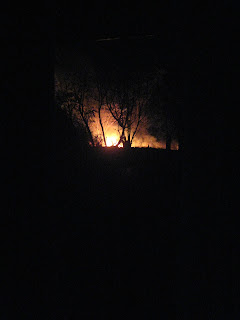
when first arriving in tanzania i was shocked by all the fires at night. i thought the whole village was burning down and didn't understand why no one was panicking. turns out before preparing their lands for planting, many farmers resort to burning their fields to finish cleaning up last year's harvest. a hazardous practice that have cost people their houses and can be very harmful to the environment.
27:something you ate.
mlenda. one of my least favorite dishes. eaten with ugali, this green goop is a common side dish in my village. with a quick snap of the wrist, getting the mlenda sufficiently wrapped around the clump of water-flour mixture is a skill that will have my neighbors clapping...once i get it right...
28:money.
this is the 10,000 shilling bill, the largest that exists in Tanzanian currency.
Its USD equivalent is about $6.50.
29:something you're listening to.
my site mate and I walked to a neighboring village for a celebration of traditional dancing and singing...just for us.
Tuesday, December 6, 2011
thankful.
Thanksgiving is never easy when you’re far from home. Especially when that home includes Annie’s famous thanksgiving potluck get together or Grama Sue’s long dining room table lined with my crazy family members and food that anyone who knows anything would travel far and wide to taste.
My second thanksgiving in Tanzania was no easier than the first. Knowing everyone back home is together celebrating (and drinking heavily no doubt) can be a little tough to stomach, especially when all I want is some damn turkey. But, if I can’t be at Annie’s or at Grama Sue’s, where else would I want to be other than Sepuka.


This year my site-mate, Kiki, and I decided to throw a Thanksgiving bash in our village (she lives about 2 kilometers away from me). We sent out word to other volunteers that we were having a shin-dig and that everyone was welcome. The response was record breaking – 15 volunteers showed up to the ‘pook to see what we had cookin’ for thanksgiving. Most traveled at least a day to get here; some traveled two days. And we did not disappoint.
With our master chef, Alana, in the kitchen (and trust me, it was her kitchen), DJ Fo on the speakers, and Rama slaughtering 4 chickens out back, it was shaping up to be an unforgettable day. Although we weren’t allowed in the kitchen for fear of getting our paws slapped, everyone pitched in to help with preparation and manning the three charcoal stoves we had going. A crate of beer, a slack line, 5 bottles of wine, hours of tunes, and four buckets of charcoal later we were more than ready to eat. The menu was as follows:
-fruit salad
-honey bread
-banana bread
-stuffing
-candied sweet potatoes
-mashed potatoes
-Shepard’s pie
-green beans
-deviled eggs
-homemade macaroni and cheese
-cranberries
-stuffed green bell peppers
-4 perfectly cooked chickens (2 types)
-pumpkin pie and;
-Alana twist yellow cake
Wow.

Our dinner guests included Mama Menga, her brother-in-law, and her son Rama. All who helped with chicken preparation that we were all too chicken to take part in. Sharing one of my favorite holidays with people from my village was my favorite part of the whole day. They ate food they’ve never dreamed of, and got to watch us run around like the fools we are, giddy with the excitement of being with friends and feasting, and got to learn more about a culture that is so foreign to them. As we went around in a circle introducing ourselves to our guests, I looked around at my friends, some new some old, and felt so completely thankful; thankful for all people who traveled to be with us, thankful for the resources and means to prepare such an amazing meal, and thankful for the opportunity to share a little America with our Tanzanian friends.


A viewing of my new favorite comedy, Bridesmaids, an after dinner treat of the best deviled eggs this side of the Serengeti, and another crate of beer were ridiculous yet oh so necessary. With mattresses borrowed from the girls hostel at the secondary school and Kiki’s 4 bedroom, 2 bathroom mansion, everyone (well, most everyone…) crashed comfortably.
Post-turkey/chicken day activities included a grand tour of Sepuka. If you’re ever in need of a little entertainment, just take a group of 15 Peace Corps volunteers around your sleepy village. We took a chai break in the village center, wandered over to my house, and then up to the primary school to check out the world map. I couldn’t tell if people were terrified or excited. Tiny heads poked out from behind their mama’s legs, village elders stared in disbelief (probably that it appeared I had so many friends), and we rambled on across farms and through houses laughing, telling stories, and greeting everyone in sight.
It was a thanksgiving celebration for the books thanks to everyone who made it possible, tasty, and thoroughly entertaining. I’m sure we’ll be the talk of the town until at least next rainy season.
My second thanksgiving in Tanzania was no easier than the first. Knowing everyone back home is together celebrating (and drinking heavily no doubt) can be a little tough to stomach, especially when all I want is some damn turkey. But, if I can’t be at Annie’s or at Grama Sue’s, where else would I want to be other than Sepuka.


This year my site-mate, Kiki, and I decided to throw a Thanksgiving bash in our village (she lives about 2 kilometers away from me). We sent out word to other volunteers that we were having a shin-dig and that everyone was welcome. The response was record breaking – 15 volunteers showed up to the ‘pook to see what we had cookin’ for thanksgiving. Most traveled at least a day to get here; some traveled two days. And we did not disappoint.
With our master chef, Alana, in the kitchen (and trust me, it was her kitchen), DJ Fo on the speakers, and Rama slaughtering 4 chickens out back, it was shaping up to be an unforgettable day. Although we weren’t allowed in the kitchen for fear of getting our paws slapped, everyone pitched in to help with preparation and manning the three charcoal stoves we had going. A crate of beer, a slack line, 5 bottles of wine, hours of tunes, and four buckets of charcoal later we were more than ready to eat. The menu was as follows:
-fruit salad
-honey bread
-banana bread
-stuffing
-candied sweet potatoes
-mashed potatoes
-Shepard’s pie
-green beans
-deviled eggs
-homemade macaroni and cheese
-cranberries
-stuffed green bell peppers
-4 perfectly cooked chickens (2 types)
-pumpkin pie and;
-Alana twist yellow cake
Wow.

Our dinner guests included Mama Menga, her brother-in-law, and her son Rama. All who helped with chicken preparation that we were all too chicken to take part in. Sharing one of my favorite holidays with people from my village was my favorite part of the whole day. They ate food they’ve never dreamed of, and got to watch us run around like the fools we are, giddy with the excitement of being with friends and feasting, and got to learn more about a culture that is so foreign to them. As we went around in a circle introducing ourselves to our guests, I looked around at my friends, some new some old, and felt so completely thankful; thankful for all people who traveled to be with us, thankful for the resources and means to prepare such an amazing meal, and thankful for the opportunity to share a little America with our Tanzanian friends.
A viewing of my new favorite comedy, Bridesmaids, an after dinner treat of the best deviled eggs this side of the Serengeti, and another crate of beer were ridiculous yet oh so necessary. With mattresses borrowed from the girls hostel at the secondary school and Kiki’s 4 bedroom, 2 bathroom mansion, everyone (well, most everyone…) crashed comfortably.
Post-turkey/chicken day activities included a grand tour of Sepuka. If you’re ever in need of a little entertainment, just take a group of 15 Peace Corps volunteers around your sleepy village. We took a chai break in the village center, wandered over to my house, and then up to the primary school to check out the world map. I couldn’t tell if people were terrified or excited. Tiny heads poked out from behind their mama’s legs, village elders stared in disbelief (probably that it appeared I had so many friends), and we rambled on across farms and through houses laughing, telling stories, and greeting everyone in sight.
It was a thanksgiving celebration for the books thanks to everyone who made it possible, tasty, and thoroughly entertaining. I’m sure we’ll be the talk of the town until at least next rainy season.
Monday, December 5, 2011
the best trip ever. part two.
Our safari was over and we still had two whole weeks left together. Great news. And the even better news was that things were about to get real.
The bus ride from Arusha to Singida is not exactly something you sign up to do for fun on a Saturday, but there we were – eating breakfast snacks we wrapped up from the hotel before getting on the bus (I had forgotten such a thing even existed, cinnamon rolls, muffins, and croissants, oh my!), eyeing a man who looked absolutely identical to Morgan Freeman and guessing as to what kind of character study he was doing undercover research for, and loving the view of the rolling hills, road construction and oncoming traffic (in which we all held our breath momentarily until a head on collision was avoided). My dad took over the demanding task of opening our bus window just as we were all about to pass out from stifling heat exhaustion and closing it as buses or huge lorries kicked up clouds of gritty red dust through our window and into our teeth. We picked up a passenger along the way who was eager to meet jeff and kath, and a few hours later we pulled into Singida for a night on the town with a gaggle of Peace Corps volunteers.

Up and down the streets of Singida we strolled, buying last minute gifts for neighbors and stocking up on fruits and veggies for the week ahead. The week ahead in my village, Sepuka.
From day one I was pumped about having my parents come visit me in Tanzania. But having them eat breakfast in my house, walk the paths between the clinic and the school and village center, climb the boulders behind my house to watch the red summer sun set, fetch bucket after bucket of water from the well, and meet and love my Tanzanian friends and family in another language was beyond words. We spent time with my counterpart’s family, toured the health clinic, checked out the World Map at the primary school, and still had time to love on my amazing site mate, Kiki, as they got a little glimpse of what my day to day looks like up close and personal. They met village government officials, my friend’s new baby, Samaki the little black kitten, my neighbors and extended family, and the countless others who greeted us as we moseyed around. We cooked dinners on my charcoal stove, and my dad fixed me up a nice stone path in my courtyard. Lazy days filled with translating ‘wow you look just like your mother!’ turned into cool nights as we cleaned rice, washed clothes and dishes, and told stories until the candles burned out. After over a year of hearing about my joys and my pains, the laughter and the tears, and the incredible moments that make my life as a peace corps volunteer worth waking up for every morning, they were finally able to live and breathe it, and begin to understand.


We hopped on a village bus passing by Sepuka and headed into Singida, spending the night in town before the last leg of our epic journey. My dad and I laughed as my mom lost the soap down the latrine hole in the bathroom. We ate ‘pizza’ at the Stanley, Singida’s classiest dining experience, and tucked under fleece blankets with puppies and ‘romantic lover dogs’ printed smack dap in the center. The next day we loaded on the bus headed to Dar es Salaam, despite the limited leg room. Looking to break the trip up a bit, we stopped in Morogoro to visit a friend who had recently started his Masters degree in environmental studies at a University there. We had lunch and told stories, answered questions and massaged our swollen feet before Humphrey escorted us back to the bus stand to catch a bus into the loud, dirty, and noisy booming city of Dar.


The rains came and went as our ferry crossed the open waters between Dar and Zanzibar. It was early morning and we were looking forward to linin’ up those chairs poolside and taking walks down one of the island’s most beautiful beaches. We arrived at Matemwe Beach mid-morning and didn’t take much time to lose the travel gear, slap on some sunscreen (thanks to our own personal cream master), and take a quick tour around the beach villas before settling into a few chairs at the pool with a great view of the white sand beach and the Indian Ocean.


We couldn’t have timed our arrival better. The full moon rose over the dark waters and lit up the beach like it was midday. Pre-dinner snacks and cocktails rang in the new moon and we made friends (of course, we’re joneses) with others visiting the Tanzanian island from all over the world. That dinner, and every other meal we had at Matemwe, was absolutely incredible. Tomato risotto, beef filets, and caramel crème dessert just to name a few, my dad and I partook in evening jogs down the beach so we could indulge in an equally exquisite meal the following day. We took walks down the wide beach as men returned from long days of fishing and women pulled in the last of their seaweed collections for the day. A dhow sailboat ride inside the reef was just what I needed. We zig-zagged into the wind and set a downwind tack for our ‘go-home’ route. Another amazing dinner and deep sleep in an air-conditioned room were just what I needed as I counted down the hours until Duncan would show up to spend the last few days with us on the island.
For someone who has been talking about going to Zanzibar since the moment we all set foot in this country, Duncan’s time at the beach was well worth the wait. Monday morning we all suited up and headed out on a small boat to a nearby island for some snorkeling. Now, my parents and I weren’t going to say anything, but I don’t think any of us expected much during this day trip. We couldn’t have been more wrong. The dinghy neared the island and one of the guides spotted a pod of dolphins surfacing to get more air just a short ways away from us. They told us to strap on those masks and get in the water as they pulled up right at the spot we had just seen these dolphins. Within seconds we had entered their underwater world, all sounds were drowned out by the absolute stillness of watching a baby dolphin nurse from its mother as she devoured a fish just below me. Soon they were swimming back up for air, around and in-between us. At one point the dolphin within 5 feet of me and I stared at it in awe, like I was intruding and watching something I shouldn’t be watching. The dolphins continued on their way, and we giddily made our way over to the reef for our scheduled snorkel tour. The fish on both sides of the island were beyond all of our wildest dreams. Blues, oranges, stripes, and polka dots flooded the spaces between the surface and the sand; the coral swayed and flowed with the current as we hovered above. We eagerly pointed out sea snakes and eels, new coral and Grama Sue’s favorite fish as we floated in our wet suits above a world we couldn’t even begin to understand the depth of. It started to get cold and the sprinkling rain wouldn’t let up so we all flipped ourselves back into the dinghy and set off back towards shore.


Dinners were a memorable time for all of us during those last few nights at the beach. Not only did we eat more delicious food as we drank bottles of red wine, but it gave Duncan and I a chance to pretend, if only for an evening, that we were just regular people on vacation, chatting and sharing embarrassing stories with my parents like normal people get to do all the time. For a short time we weren’t Peace Corps volunteers living amongst absurd poverty, we were normal people (I was even in a dress that stopped above my knee) out to dinner with my parents and it meant more than either one of us could express.


On the second to last day of our trip we left the resort and headed into Stone Town, the main city of Zanzibar located on the west coast of the island. The town center boasts the culture and heritage of both the old slave trade and the internationally renowned spice trade. Mazes and narrow alleys make up the heart of Stone Town, it’s shops, old carved wood doors, mosques, bazaars, and late night street food at the waterfront make this old city a hotspot for tourists while taking pride in the unique culture and history of Zanzibar.


The goodbye seemed to get harder the more days there were after the time we watched them walk through security at the airport. My dad put it best, ‘I didn’t realized how much I missed you until I saw you.’ Thanks mom and dad, for your unconditional love and support of whatever adventure I seem to find myself on. I wouldn’t be who I am today if you weren’t there with my every step of the way. I love you.
The bus ride from Arusha to Singida is not exactly something you sign up to do for fun on a Saturday, but there we were – eating breakfast snacks we wrapped up from the hotel before getting on the bus (I had forgotten such a thing even existed, cinnamon rolls, muffins, and croissants, oh my!), eyeing a man who looked absolutely identical to Morgan Freeman and guessing as to what kind of character study he was doing undercover research for, and loving the view of the rolling hills, road construction and oncoming traffic (in which we all held our breath momentarily until a head on collision was avoided). My dad took over the demanding task of opening our bus window just as we were all about to pass out from stifling heat exhaustion and closing it as buses or huge lorries kicked up clouds of gritty red dust through our window and into our teeth. We picked up a passenger along the way who was eager to meet jeff and kath, and a few hours later we pulled into Singida for a night on the town with a gaggle of Peace Corps volunteers.
Up and down the streets of Singida we strolled, buying last minute gifts for neighbors and stocking up on fruits and veggies for the week ahead. The week ahead in my village, Sepuka.
From day one I was pumped about having my parents come visit me in Tanzania. But having them eat breakfast in my house, walk the paths between the clinic and the school and village center, climb the boulders behind my house to watch the red summer sun set, fetch bucket after bucket of water from the well, and meet and love my Tanzanian friends and family in another language was beyond words. We spent time with my counterpart’s family, toured the health clinic, checked out the World Map at the primary school, and still had time to love on my amazing site mate, Kiki, as they got a little glimpse of what my day to day looks like up close and personal. They met village government officials, my friend’s new baby, Samaki the little black kitten, my neighbors and extended family, and the countless others who greeted us as we moseyed around. We cooked dinners on my charcoal stove, and my dad fixed me up a nice stone path in my courtyard. Lazy days filled with translating ‘wow you look just like your mother!’ turned into cool nights as we cleaned rice, washed clothes and dishes, and told stories until the candles burned out. After over a year of hearing about my joys and my pains, the laughter and the tears, and the incredible moments that make my life as a peace corps volunteer worth waking up for every morning, they were finally able to live and breathe it, and begin to understand.


We hopped on a village bus passing by Sepuka and headed into Singida, spending the night in town before the last leg of our epic journey. My dad and I laughed as my mom lost the soap down the latrine hole in the bathroom. We ate ‘pizza’ at the Stanley, Singida’s classiest dining experience, and tucked under fleece blankets with puppies and ‘romantic lover dogs’ printed smack dap in the center. The next day we loaded on the bus headed to Dar es Salaam, despite the limited leg room. Looking to break the trip up a bit, we stopped in Morogoro to visit a friend who had recently started his Masters degree in environmental studies at a University there. We had lunch and told stories, answered questions and massaged our swollen feet before Humphrey escorted us back to the bus stand to catch a bus into the loud, dirty, and noisy booming city of Dar.

The rains came and went as our ferry crossed the open waters between Dar and Zanzibar. It was early morning and we were looking forward to linin’ up those chairs poolside and taking walks down one of the island’s most beautiful beaches. We arrived at Matemwe Beach mid-morning and didn’t take much time to lose the travel gear, slap on some sunscreen (thanks to our own personal cream master), and take a quick tour around the beach villas before settling into a few chairs at the pool with a great view of the white sand beach and the Indian Ocean.
We couldn’t have timed our arrival better. The full moon rose over the dark waters and lit up the beach like it was midday. Pre-dinner snacks and cocktails rang in the new moon and we made friends (of course, we’re joneses) with others visiting the Tanzanian island from all over the world. That dinner, and every other meal we had at Matemwe, was absolutely incredible. Tomato risotto, beef filets, and caramel crème dessert just to name a few, my dad and I partook in evening jogs down the beach so we could indulge in an equally exquisite meal the following day. We took walks down the wide beach as men returned from long days of fishing and women pulled in the last of their seaweed collections for the day. A dhow sailboat ride inside the reef was just what I needed. We zig-zagged into the wind and set a downwind tack for our ‘go-home’ route. Another amazing dinner and deep sleep in an air-conditioned room were just what I needed as I counted down the hours until Duncan would show up to spend the last few days with us on the island.
For someone who has been talking about going to Zanzibar since the moment we all set foot in this country, Duncan’s time at the beach was well worth the wait. Monday morning we all suited up and headed out on a small boat to a nearby island for some snorkeling. Now, my parents and I weren’t going to say anything, but I don’t think any of us expected much during this day trip. We couldn’t have been more wrong. The dinghy neared the island and one of the guides spotted a pod of dolphins surfacing to get more air just a short ways away from us. They told us to strap on those masks and get in the water as they pulled up right at the spot we had just seen these dolphins. Within seconds we had entered their underwater world, all sounds were drowned out by the absolute stillness of watching a baby dolphin nurse from its mother as she devoured a fish just below me. Soon they were swimming back up for air, around and in-between us. At one point the dolphin within 5 feet of me and I stared at it in awe, like I was intruding and watching something I shouldn’t be watching. The dolphins continued on their way, and we giddily made our way over to the reef for our scheduled snorkel tour. The fish on both sides of the island were beyond all of our wildest dreams. Blues, oranges, stripes, and polka dots flooded the spaces between the surface and the sand; the coral swayed and flowed with the current as we hovered above. We eagerly pointed out sea snakes and eels, new coral and Grama Sue’s favorite fish as we floated in our wet suits above a world we couldn’t even begin to understand the depth of. It started to get cold and the sprinkling rain wouldn’t let up so we all flipped ourselves back into the dinghy and set off back towards shore.

Dinners were a memorable time for all of us during those last few nights at the beach. Not only did we eat more delicious food as we drank bottles of red wine, but it gave Duncan and I a chance to pretend, if only for an evening, that we were just regular people on vacation, chatting and sharing embarrassing stories with my parents like normal people get to do all the time. For a short time we weren’t Peace Corps volunteers living amongst absurd poverty, we were normal people (I was even in a dress that stopped above my knee) out to dinner with my parents and it meant more than either one of us could express.

On the second to last day of our trip we left the resort and headed into Stone Town, the main city of Zanzibar located on the west coast of the island. The town center boasts the culture and heritage of both the old slave trade and the internationally renowned spice trade. Mazes and narrow alleys make up the heart of Stone Town, it’s shops, old carved wood doors, mosques, bazaars, and late night street food at the waterfront make this old city a hotspot for tourists while taking pride in the unique culture and history of Zanzibar.


The goodbye seemed to get harder the more days there were after the time we watched them walk through security at the airport. My dad put it best, ‘I didn’t realized how much I missed you until I saw you.’ Thanks mom and dad, for your unconditional love and support of whatever adventure I seem to find myself on. I wouldn’t be who I am today if you weren’t there with my every step of the way. I love you.
Subscribe to:
Posts (Atom)