Well it has been a long time since you all last heard from me and I'm oh so sorry. Everytime I sat down to write a blog post I didn't even know where to start, so I just didn't. ha. But now I swear to you my faithful followers that I will do better!
It's been about 5 weeks now since my welcoming party on August 21st. I've been settling into my new life slowly but surely - setting up my house, eating with neighbors, visiting the primary and secondary schools, practicing my new language and hopelessly searching for anyone who speaks english (no such luck yet...), hanging out with the nurses at the clinic, and my favorite pasttime: watching regular soccer games in the center of my village.
I love my village. It's on the main road to Songea, and only about an hour or two outside of town. After debarking from the daladala (amazing van that can somehow hold and infinate amount of people, I counted almost 40 in one last weekend, with actual seats for about 15) in Ngadinda, you see the pool table and duka la dawa (medicine shop) to the right, and follow the main path back towards the village center. One thing I like about my village is how centralized it seems. After following the path lined with homes back about 5 minutes you see the primary school on the right and the health clinic on the left. My house is just behind the clinic and was actually built for the doctor, but they were transfered out of the village years ago and now there isn't a doctor. A good amount of my villagers actually think I'm the doctor, which I can see how they would get that idea, but has led to a few very confusing conversations in which I've been asked to deliver babies or treat a child's burns. Anyways, following the main path still, just after the clinic and school there are two main water pumps, the village leaders "offices", followed by the regulation sized football field and a very german style catholic church. There are about 3,000 people in the village, and the houses spread far, for almost 3 km in every direction from this central part. The village is split into 8 neighborhood/settlements, and I'm working on visiting all of them by the end of the month, 3 down so far.
So my first week in the village was a lot of meeting neighbors, figuring out how to get water, what food is available in my village, and plenty of "what in the world am I doing here??". My VEO (village executive officer, aka Mama Mango) and her husband have taken me under their wing and wouldn't let a day go buy without feeding me massive amounts of ugali (corn flour stirred aggressively into boiling water - google it) and trying to figure out why I keep refusing meat? hmm maybe it's because Tanzanians like eating fat and sucking on bones? They still don't understand and I think they believe everyone in america doesn't eat meat. Sorry about that one. I did my best to explain! There isn't a great variety of food available in my village. Mostly rice, beans, ugali flour, cassava, some tomatoes and small onions. I can also get eggs and little candies at the duka (shop). In town (Songea) I can get carrots, green peppers, spices, apples, oranges, and the occassional avocado which makes me extremely happy. There are mango trees everywhere in my village and word on the dirt path says they start to show up around december.
My Swahili is coming along, it's hard to tell if I'm making progress, but I'm learning new words every day. I carry around a little notebook and my dictionary with me everywhere, looking up and writing down vocabulary and making flashcards (that I haven't actually used yet, but I do make them!) Sometimes I shock myself when whole sentaces come out and the person on the other end actually understands. Those are very happy moments. Like I said, I have yet to find anyone in my village who speaks English, which can lead to very long, exhausing, and sometimes frustrating days of piecing together conversations. There are a few people who know some English vocabulary, and one guy whose english is about like my swahili, so he helped me at a meeting last week. There are a few teachers at the secondary school who speak beautiful english, but it's about 4 kilometers outside my village and they all live at the secondary school. I get along with a few of those teachers really well and am excited to work with them (eventually) teaching life skills at the school. I can't wait for the day where this lovely language flows effortlessly out of me, but until then I'm stickin with the people who speak slow and have the patience to watch me look up words.
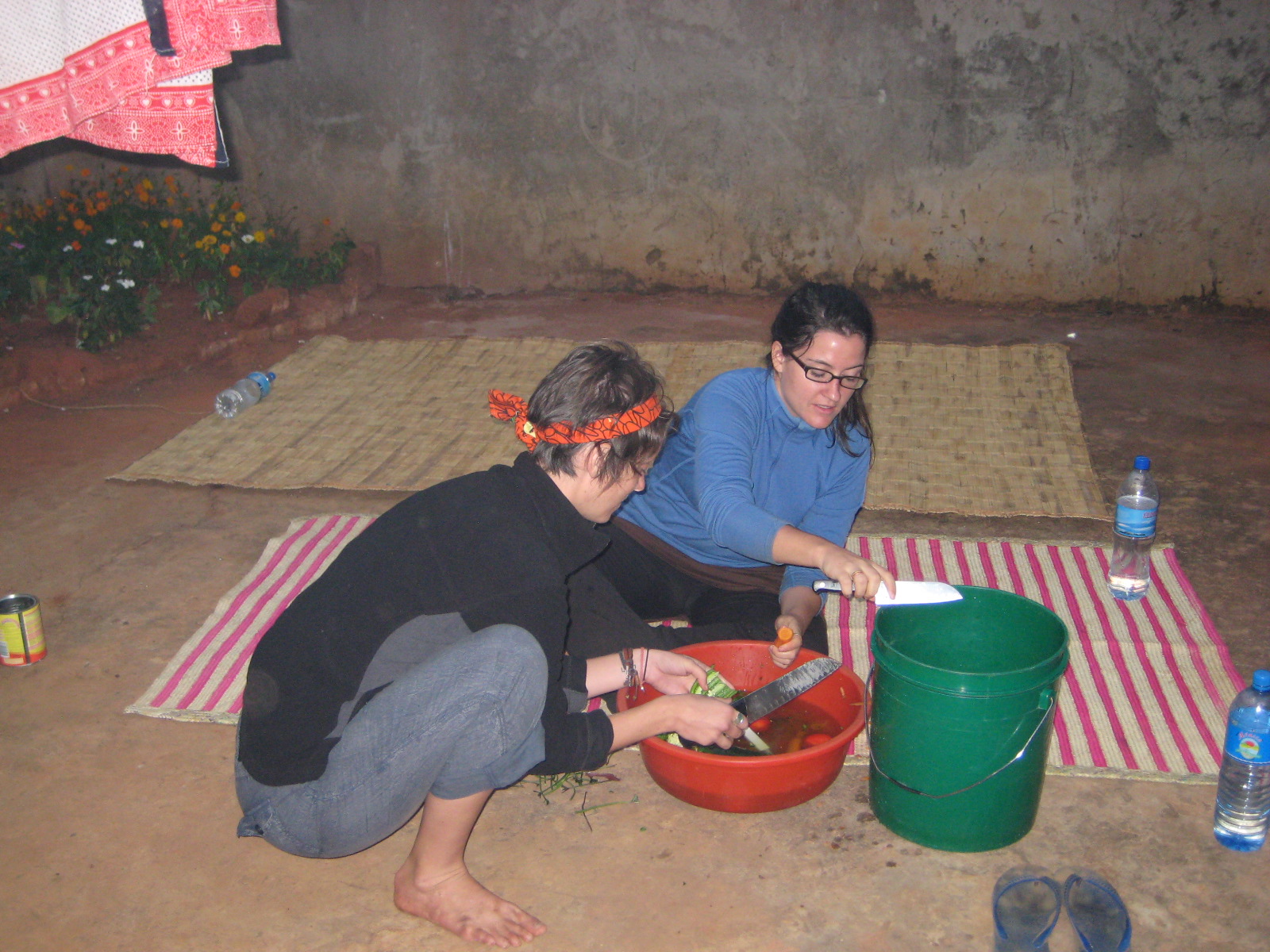
So what's a day in the life of Alli in a rural african village look like at this point? Well I'll tell you. The primary school bell rings every half hour starting at 6:30 am which is the most obnoxious alarm clock. Wait, I take that back. The roosters are the worst alarm clock. At least the bell is predictable. I usually roll out of bed around 8 and light the coals to boil water for oatmeal and tea. If i'm not interupted by the swarms of students running by my house, I can usually manage to hide in my house and read until around 10am. Then I wander out waiting for a neighbor, mama mango, or one of the nurses to invite me to chai. I think it's a good way for me to get out of my house, socialize with people, and get chai usually accompanied by boiled cassava, sweet potatoes, or andazi (kind of like a plain donught maybe?). I wander around some more, greeting people with the plethera of greetings this culture employs, maybe hang out at the pool table next to the road, or sit at the mghawa (cafe) and help my (only) friend cook. Then sometimes she feeds me, or I go home to cook rice and beans followed usually by a nap. After my brain has recovered from a morning of swahili, I venture back out to meet more people and just try to stay busy. My Baba (my african daddy) has been taking me to visit different "neighborhoods" in the village and introducing me to people. He has been so helpful in helping me adjust and get to know my surroundings, making me feel at home, telling me who certain people are, and making me laugh. He is an amazing man, he speaks such great swahili with me, is patient, and is clearly respected in the village yet is very humble. My daddy away from home (but no replacement dad, don't worry:)) My villagers have caught on to how much I love watching the village soccer league and come to get me if there is ever a game, or even a practice. My VEO sets up a chair for me in front of her house so I have a front row seat. At the very beginning it was actally a great way for me to get out of hiding in my house and be seen by my villagers without having to talk a whole lot which I was fine with by the end of the day. More recently I've been spending more evening time at home, cooking or reading, and more time during the day out of my house getting to know people. At night I also use my charcoal jiko (stove) to heat up water for a bucket bath (which should probably be happening more frequently than it does...) and am dead asleep by 9pm if I can.
I would like to close this entry with a few things that I love about Tanzania so far: the endless amusement second hand t-shirts from America bring me, one of my favorites thus far has been a purple taco bell uniform. Also, laughing. I know they are mostly laughing at me, but it helps that I'm also good at laughing at me. I am well aware that carrying a 20liter bucket of water on my head is hilarious (and no fun at all) and gladly make light of it by stopping to do a little jig while walking past groups of women peeing themselves with laughter.
So three and a half months down, and a long ways to go, but I'm starting to feel more comfortable in my village and am excited to start my first meetings this week. Although I absolutely have days where I consider going home just because I could get ice cubes there, at the end of the day (well, most of them) I'm feeling good about being here.
Until next time, look out for rats falling from the ceiling as you squat on the choo, those things are rutheless...
Monday, September 27, 2010

Saturday, August 28, 2010




Tuesday, August 17, 2010
Another big move
This morning I had to say goodbye to my second family in two months. Finished with training meant finished with homestay and goodbye to the Masawe family. I never thought I would become so attached to them, saying goodbye was not easy.
Now I(we all) are in Dar es Salaam for a few days in order to swear in as official Peace Corps volunteers. I'll move to my village after that (I should get there on Saturday if everything goes as planned...) and then I'll be on my own to start working. Well actually our job for the first three months is basically to survive. Get to know our village and villagers, what the needs of the village are, be able to cook my own food, fix my own water, and hopefully pick up a lot of Kiswahili as I will be without any english speakers. Sounds fun right? Well we'll see. I'm sure I'll have a lot to update on in a few weeks! I'm so excited to get started in my village and see what I can really do!
Oh, and here's a picture of the latest haricut that my baba (dad) gave me. He was trying to help and went a little short, so we had to take more off than expected. I just let him have at it (I actually didn't have much of a choice, he was so excited and wanted to help so bad, I mean, it was pretty funny.) I'm thinking of going with a faux-hawk from here...
Tuesday, August 3, 2010
pre-service training aka PST.
-->
 The Masawe Family!
 This is my coloring group...we're still learning how to use markers....
 Me (looking very native) and Rebecca sitting and Sarah standing in a ridiculous fashion behind us. (at MATI)
 Me with the neighbor kids, practicing taking pictures... and yes, my friend Sativa cut my hair!
August 2. 2010.
This is quite the task. Sum up my first six and a half weeks living in Africa in a blog. But I am able to handle just about anything at this point so here goes....
We are still in training right now. Currently I am shadowing a Peace Corps volunteer who has been in country for a year in order to get an idea of what it’s like to be a PCV and meet other volunteers. It's been such a nice break from training and I got the special treat of shadowing in the village next to the village I'll be living in for the next 2 years! My lovely neighbor-to-be Amanda is hosting a few of us at her beautiful house showing us around her village, teaching us how to cook such great food with local ingredients and giving us tips about village life in the Peace Corps. We’ve also been hanging out with a few other Peace Corps Volunteers who live in the region and I’m so excited to live here and work (and play) with these wonderful people! Yay for Kelly, Amanda, Erica, Jack, and Bill!
So the past 6 weeks we've been living in the Muheza district near the city of Tanga. It's in northeastern Tanzania - check it out on a map. We're split into small groups called Community Based Training(CBT) groups. There are 5 people in my group and we live a village called Bagamoyo. The first few weeks of training we met every day in a room of one of the houses and learned Kiswahili all day. The amount we learned in 3 weeks was incredible and equivalent to a six month language course, which was so helpful but no match for the regular communication breakdowns and language barriers. For the past few weeks we've been meeting together as a whole training class (there are 40 of us!) and having technical training about what we are going to be doing at our sites. For most of our technical sessions they split us into health and environment groups. As health volunteers we've been learning about HIV/AIDS, Malaria, teaching primary health care, nutrition, water borne diseases, health care in Tanzania, and so so much more. There is so much to learn about the language, culture, and our technical tasks that 9 weeks is no where near enough time to figure out what in the world we're supposed to do. But the goal is not to teach us everything, but to give us an idea of where to start. As health and environment volunteers we don't have structure like the education volunteers teaching in the schools everyday, but our job is to assess what the village needs and wants are and create projects that help villagers help themselves. Some health volunteers work with womens groups creating income generating projects such as making soap, bags, or starting small businesses. Other volunteers have created HIV/AIDS support groups, or are working with Orphans and Vulnerable Children (OVCS) and out of school youth. There is so much flexibility in what we can do, and it all varies from village to village depending on what the needs of the village are.
But that's enough about the unpredictible future, how about some more info on what's happening now...
For training like I said, I'm living in the village of Bagamoyo with the Masawe family. I have a Mama, Baba (dad), two Kaka (brothers), and one Dada (sister). Baba's name is Prosper (age 40 something), Mama is Majube (age maybe 40?), my Kakas are Matei (age 2) and Karoli (age 7), and my dada is Rizeiki (age 11). I also have a wonderfully entertaining Bibi (grama, age unknown but definitely up there) who is always apologizing to me for some reason and who I taught how to play frisbee. It was a rough start, as you can imagine it would be moving into a family's house who speaks a completely different language with a very different way of life. We worked it out, I am able to communicate a little bit better now and they know me know so everything is great.
Our daily routine consists of me waking up at approximately 6am when Martinez my bat enters the room. He flaps around eating mosquitos and is a very effective alarm clock. After he settles in his corner and I feel it safe to exit my mosquito net without being attacked, I walk around my house greeting my family (greetings are very important in Tanzania culture, sometimes greetings alone can take up 5 minutes per person and consist of a Shikamoo given to everyone who is older than you which means “I take your feet”, how did you wake, how did you sleep, whats the news, how is your morning, how is your farm, how is your house, how is your family, and so on. Many classes were devoted solely to greetings...). After the greetings my mama gives me warm water to take a bucket bath with. I am now able to bathe with less than 10 liters of water each time, for some reason I am required to bathe twice a day and when you do the math it ends up being about a 400% increase from how many times I bathed in the states. So after my morning bucket bath I sweep my room and have chai with my mama. She makes me tea every morning along with 2 chapati (kind of like flatbread) or Mandazi (fried bread triangles). I head out around 730 picking up Lauren who lives closest to me and we meet up with Tala, Katie, and Kenzie to either have class in Bagamoyo or go to MATI where all of the groups come together for those technical sessions. After school we head back to Bagamoyo and either study or take walks to our secret hide out behind the church. I usually go back to my house around 630, hang out with my family or study. Most recently a coloring group has started in the evenings due to the wonderful gift of markers my family sent me. There are about 10 kids who sit on our front porch drawing pictures of houses, cars, people, tracing their hands, flowers, or drawing pretend sunflower tattoos on their arms and/or legs. Oops. My mama gives me more water to take another bucket bath, we eat around 8, watch the moon for a while because I continue to freak out about how beautiful it is every night, and I go to bed tucking myself inside my net and blowing out my lantern.
Its amazing the things that are normal and a part of my everyday life. From using a choo (squat toilet) and learning to shine my lantern into the choo at night to scare away the cockroaches before I enter, to having a pet bat, boiling water to drink, eating rice and beans twice a day, spending time with amazing Tanzanians who are wonderful, peaceful, welcoming, and happy despite living in poverty day in and day out, and watching the sun rise and set every day. I taught my dada how to blow kisses and we blow each other kisses all the time. My kaka (matei, the 2 year old) has a really big problem with my cat climbing into my lap and will repeatedly remove her by her head and throw her on the ground, only to have her crawl back on my lap and the cycle begins again sometimes lasting for 30 minutes. It’s hilarious.
Being immersed into a culture so different from ours has and will continue to be an amazing experience. Learning a new language, beautiful traditions, distinct gender roles, how to dress and interact with people, how to use local resources, and what not to do when the village guards are training are only a few of the things I’m starting to figure out.
After we return from shadowing we have a few more days in our homestays before we say goodbye to them, take our final oral proficiency test and swear in as Peace Corps Volunteers on August 19th. After that we are sent all over Tanzania to our villages and begin our two year service at our sites.
We got our sites last week, I am placed in the Rumuva District in the southern highlands. The closest larger city is called Songea my village is called Ngadinda which is just north of Songea and about 10km from Amanda’s village. I was able to get a sneak peak of my site yesterday since I’m shadowing at Amanda’s (I’m the only volunteer who got to shadow near their siteJ). We visited my house which is beautiful and walked around the village a little bit. The health clinic is basically in my front yard, the primary school is around the corner from that, and just beyond the primary school is a huge soccer field and really nice church. I met a few of the village officials, and it took a ton of pressure and stress off of that initial drop at my site. I am so excited to settle down there in a few weeks and start to figure out where I fit in to life in Ngadinda.
I will post a new address when I get settled, until then hold off on all of those letters and packages. I will also update a list of things I might need or want from the states. Getting mail is something that might end up keeping me sane, so please don’t hesitate to send some love!
Hope you enjoy these few pictures of my life at home in Bagamoyo...A family picture, me with my dada and two kakas, the loves of my life Sarah and Rebecca, and my coloring group...(the video won't load, sorry!)
Love you all!
 The Masawe Family!

 This is my coloring group...we're still learning how to use markers....
 Me (looking very native) and Rebecca sitting and Sarah standing in a ridiculous fashion behind us. (at MATI)
 Me with the neighbor kids, practicing taking pictures... and yes, my friend Sativa cut my hair!
Tuesday, June 22, 2010
Karibu Tanzania!
After 9 months of anticipation, weeks of goodbyes, and 18 hours on a plane, I finally made it to Peace Corps Tanzania. Our staging event was in Philadelphia where we went over some general expectations and rules about Peace Corps. It was nice to be with the whole group to travel over here, we all learned that we had very similar anxieties and it was good to be with a group who was going through the same things. There are 41 total people in our group - 25 health volunteers and 16 environment volunteers.
We got into Dar es Salaam in the evening of June 16th, were herded into buses and headed for the Msimbazi center. It's basically a hostel/college run by nuns who have crazy parties on saturday and sunday nights. We started sessions (classes) right away on Thursday morning. Our classes are pretty general at this point, focusing on Tanzanian culture, Peace Corps goals and expectations, some Kiswahili lessons, safety and security, what to expect at homestay, and introductions of our training staff. There are 29 PC Tanzania staff, and only 4 of them are American. It's so great to be learning from Tanzanians who are excited to have us here and want to help us succeed. If I've learned one thing so far (and it's not much swahili), I've learned that Tanzanians are the most kind, welcoming, funny people I've ever met. They mentioned to us in one of our sessions that although the police don't have a strong presence or role in dealing with crime or things of that nature, that Tanzanians will do anything they can to protect us and take care of us if we integrate well into their community. This mostly means learning the language (or at least enough to partake in the 5 minute initial greeting of a collegue, friend or family member) and being culturally appropriate with dress and social norms. Our sessions so far have been great in helping us get a start on understanding these things.
On wednesday we move 5 hours north to the town of Muheza where we'll spend 9 weeks in Community Based Training. We are divided into small groups, there are 5 girls in my group, and we'll be living in the same village right outside the main town for the duration of training. We'll each be living with a Tanzanian family who has volunteered to take us into their home as one of their children. Our mama's and baba's will teach us to cook, do laundry, chores, kiswahili and other culture norms among many other things I'm sure. From what I've heard it is extremely awkward for a good amount of the time, as we're trying to communicate and understand each other. I've also learned that Tanzanians like to laugh at just about anything we do, so at least there's a lot of humor going on because it's going to be ridiculous. I'm really excited about homestay and can't wait to meet my family - I just hope my Kiswahili really picks up or we could have some seriously long days of staring at each other.
The schedule during training consists of classes with our Language/Culture Facilitators during the day in our village, monday through thursday, and whole group sessions on fridays. I'm not exactly sure what the main town of Muheza is like or how often we go into town, but I'm hoping to get a cell phone within the next couple of weeks. It sounds like our internet access will be minimal during training, but I'll update when I can.
I'm having such an amazing time here so far with these phenominal people in AFRICA! There are people from all over the country who come with such diverse experiences and backgrounds. We were talking tonight how we can't believe it was only a week ago that we all met, everyone is great and we get along so well.
Side notes:
- I learned how to take a shower using only 5 liters of water in a bucket.
- I have 21 mosquite bites, all from the knees down.
-If you're thinking about sending packages or love notes, we can recieve mail here in Dar for the next 6 months;
Alli Jones
US Peace Corps
PO Box 9123
Dar es Salaam, Tanzania
Some mailing tips we've received include writing "school supplies," "Religious Materials" or "jesus loves you", etc on the outside of a package to scare away customs agents from rummaging through stuff. They also said that if you're sending something that they might want to keep, to use creative packaging like hiding it in a tampon box or somthing of that nature. Please send me things if you can - I would love to get mail especially with such limited access to communicating with you guys. Letters would be great:)
Well I'm going to climb under my mosquito net and get some sleep...
usiku mwema! (good night!)
packing
Packing list. Here's what I brought with me. Requirements: 2 checked bags under 80 lbs total, 1 carry on - not impossible.
In the 50+10 Deuter backpack:
Sleeping bag
Top/flat sheet
Headlamp
Raincoat
Tampons
1 thin fleece
1 nike half-zip
1 long sleeved shirt
6 "blouses" (whatever that means)
3 t-shirts
3 tank tops (recommendation: get the ones that have the bra on the inside to hold money for security purposes)
1 pair jeans
2 shorts to sleep in
4 skirts (mid-calf/ankle length to be culturally appropriate)
2 pairs loose/baggy capris (1 is quick-dry material)
2 long (loose fitting) pants (wish I would have brought leggings to wear under my Kanga)
10 undies, 6 pairs/socks
ihome portable speakers for ipod
In the small duffel bag:
4 books
bike helmet with flames on it (you can get kicked out if you're caught riding a bike without one: no joke)
presents for host family (puzzle, braclets, cheap girly hair stuff, coloring pads, crayons: I'm planning on getting a Kanga for my host mama and a knife for my host baba)
78 kashi granola bars (thanks kath)
quick dry travel towel
toiletries: toothbrush, toothpaste, 3 bars soap, deoderant, sunscreen, floss, q-tips, nail clippers, tweezers, advil, hydrocortozone cream that doesn't work, 1 shampoo, small bottle of all purpose laundry soap, dish detergent (good for washing essential items before going to homestay)
diva cup (good alternative to tampons)
batteries
small alarm clock
small cutting board, skillet, kitchen knife
small notebooks (wish I would have brought flashcards)
lots of pictures of friends & family
pens, sharpies (wish I would have brought markers and highlighters)
bug spray that doesn't work
shoes: chacos, rainbow, toms, running shoes (for all of the running I do)
outlet converter (here they have both British and Europe outlets)
leatherman multitool
In the Mountainsmith carry on:
Netbook (probably about half of our group brought computers, but I'm glad I did)
Camera
journal
book
playing cards, uno, skip-bo
ipod
nalgene
travel pillow strapped to the outside thanks to Jeff's bungee cords
swahili dictionary
What i've bought here so far:
larger spiral notebook
peanut butter
3 Kangas (large pieces of fabric used as skirts or can be turned into dress/shirt/anything)
lock for luggage
more q-tips
toilet paper
I cannot believe it all fit and I was way under weight limit.
Also, PC gave us a ridiculous first aid kit including anything medically you could ever imagine needing (plus mosquito netting.) They also took us into the market on our 4th day here to get things in case we had run out or forgot something important. I was pretty proud of the packing job, couldn't have done it without input from other Peace Corps blogs and tips from family and friends who had traveled to africa, thanks!
Subscribe to:
Posts (Atom)